WHEW! There was a lot of information tonight, but so helpful! I can't wait to try out many of these strategies that we talked about. The two strategies that I would like to take a shot at on my lesson plans are RAFT and Anticipation Guides.
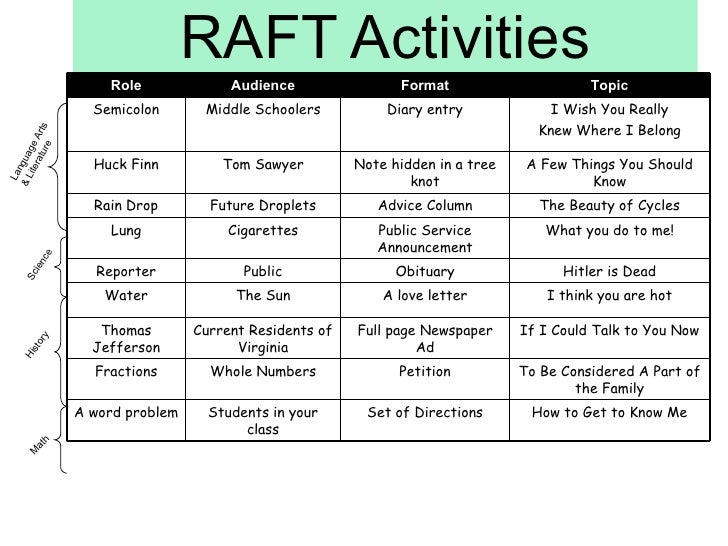

I have never heard of RAFT, but I definitely enjoyed the concept. It intrigued me, and I feel the students will be engaged and pay attention to the activities. Since I'm working on my middle school certification in English, I felt it would be a great way to get them to think about what to write and adding some creativity to the mix.
Role
Audience
Format
Topic
There are so many ways to set up RAFT which you can see an example below. I didn't know that it was another way of doing a choice board, but more specific!
Since I'm doing English, let's try one of the activities above. Let's do Huck Finn! Pretend you are Huck Finn (that is your role) and you will be speaking to Tom Sawyer (the audience) and writing a note to him that is in a tree knot (format). The note will be about "A Few Things You Should Know" (topic). This gives the students a chance to get creative and give Tom Sawyer some advice.
Example:
Dear Tom,
Guess what? There are a few things you should know about what I saw...(Kids can fill in the rest.)
Pretty cool, huh?
Another reading strategy that I found interesting were the Anticipation Guides. I think it requires work, but it is a good front loader activity. We watched the following video in class which explains how to use Anticipation Guides:
1. As a teacher, I will have to identify the major ideas and concepts in the text that the students will be reading and learning about.
2. The students need to predict what they might already know about the topic by answering questions with "true, false, or I don't know."
3. They can then share this with their partner and explain why. This helps with cooperative learning! Yay!
4. An Anticipation Guide with four to six statements will be made that will challenge or change the students' predictions. They will be reading the text so if it changes or challenges their predictions, they will need to write the page number of where they found their information/evidence from.
5. Lastly, they will be able to debate their answers in class with evidence. They should not just read from the text verbatim, but be able to summarize what they have learned.
Here is an example of an Anticipation Guide I found:
Since I did a unit plan on Romeo and Juliet last semester, I found the above Anticipation Guide interesting and helpful.
Hope you learned a few things from my blog post and got some new ideas and resources. Until next time...
As I was watching the anticipation guide I was thinking that it would make for a great introduction to a chapter or unit. Students have to skim and dig hot topic areas instead of being forced to focus upon the whole chapter at once. My more creative students loved the RAFT. They could let their creative juices flow, yet at the same time directed those creative thoughts for those who struggled.
ReplyDeleteYes. I don't consider myself as creative as others, but it is good to challenge myself and work in those areas. It helps us to grow, and I definitely need that!
DeleteI thought the RAFT strategy was a good one as well. I had never heard of it either until this class. There are so many strategies out there it makes it nice to be able to pick and choose which ones we relate to. It's helpful because some lessons may not work well with certain strategies, so it provides us with more options.
ReplyDeleteWow, thank you for posting such great examples of the RAFT method and anticipation guide. I liked how you used Tom Sawyer and Huck Finn to exemplify how to use the RAFT method. This helped me understand it even better. I feel like this engages the students better in the activity as well. Also, the anticipation guide you showed as your example; was a neat way for allowing students to better understand Romeo and Juliet. This would have been useful for the highschool students, I was substitute teaching, to understand Romeo and Juliet a little better or just be more engaged while watching the movie. Thanks for these wonderful ideas.
ReplyDeleteI am really glad that you explained how to execute the RAFT strategy step by step. I was intrigued by the explanation in class, but I didn't fully grasp the concept until now! So thank you so much!! The best part of this strategy to me is that it allows for a little creative freedom for the students while still controlling that they accomplish your objective.
ReplyDeleteYour blog is set up very nicely. It's clear and easy to read. You have done a great job.
I love the way you explained the raft it definitely helped my understanding!
ReplyDelete